Page 9 of 26

SMALL BUSINESS “EVERYDAY”

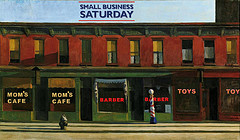
Saturday November 24th is “Small Business Saturday.”  I encourage every American to spend some time, and some “money,” at your local “neighborhood” retailer.  But, the more we look at what the large retailers, the “big box” stores, have done to our local enterprises, and our local economies, the more we should understand why small business Saturday, should be “Small Business Everyday.”

You can probably see by my whiskers that I’m a child of a slightly different era.  It was a time when a bell rang when you pulled into the corner gas station and an attendant came out to pump your gas.  You actually had to ask to pump your own.  I remember them asking if I wanted them to check under the hood.  They noticed if your tires were a little low.  They cleaned your windshield for you, without you asking.  The big store in our neighborhood was the A&P.  It was located in a little “strip mall” not a mile away.  Walking distance, even with an arm full of groceries.  Along the way their were several markets, dry cleaners, and several other small businesses.  In that particular strip mall was, along with the supermarket was a 5 & 10 cent store (S. S. Kresge’s), Mrs Silverstein‘s clothing store, and Cunningham’s Drugs store.  There were others, sorry, but memory fails me.

Along that route were two stores that stand out in my memory.  There was the “Mapleview Market” and “Gus’.”  The street corners they sat on would only be important to those who lived near them at that time, but most of us, from that time, will have memories just like them.

What’s important to remember is that these stores shared a space in time.  Yes, they competed, but they shared a common resource.  The neighborhood.  At different times growing up I must have worked at each of them.  In fact I remember working at the Mapleview Market when the butcher ran out of bologna and he had me run up the Gus’ market and get a roll.  You remember those large, log looking rolls, wrapped in red.  I never knew what that red cover was, and I didn’t want to, so I never asked.

The thing is, there was a social thing going on.  Not socialism. that feared word.  But social in the sense of a shared circumstance, and ultimately a shared outcome.  In many instances the store owner or manager lived right there in the neighborhood.  We knew each other and we benefited from that knowledge.

Another benefit was that the “money” resource stayed right there in the neighborhood.  It would be impossible to calculate just how many times a dollar bill circulated within the area.  I know I saw the same dollar, with the same writing on it, many times.  The same quarter, with the dye on it from the laundromat or a vending machine.

But, times changed.  Cunningham’s was bought out,  Kresge’s became K-mart, A&P’s became Farmer Jack and then disappeared, at least from the old neighborhood.

Now some will say that, well, that’s just progress.  And to the extent that change can be called evolution, and evolution can be called progress, maybe that’s so.  We grow and we change.  But what have we  become?

Much has already been written about the impact of “Big Box” stores, and large chains on neighborhoods and even small towns and cities..

The large chains come into areas and began to buy out many of the existing businesses.  Right away the impact was felt as the resources no longer circulated as much through the neighborhoods.  As businesses are consolidated, or absorbed, jobs were lost and the social structure begin to crumble.  The small businesses that remain, unable to compete with the per unit cost for products, of the larger stores, are forced to close.

As the social structure changes so do relationships and attitudes.  The connectivity begins to erode.  Where people were in touch with each other, passing each other, smiling, greeting, shaking hands, we are now in our cars (those that have them), off to where the stores are, taking our resources with us.

These are my personal thoughts and memories.  I’m providing some links to several sites that offer further comments on this subject.

http://www.allfreeessays.com/essays/The-Effects-Of-Big-Business-On/220977.html

http://www.ilsr.org/key-studies-walmart-and-bigbox-retail/

http://www.msnbc.msn.com/id/4001039/ns/business-small_business/t/big-store-or-small-why-consumers-care/#.UKhCleTAetp

You can find more by searching:  “effect of big box stores on neighborhood businesses”

I also found an excellent tool for evaluating the possible of effect of the encroachment of large chains and big box stores to different size and demographic locations that, if you are considering one for your area, or if one is pending, you might want to use.

http://www.bigboxevaluator.org/

(If you are unable to click on these URL’s, copy and paste them to your search box)

It’s hard not to notice what is happening at the Wal-Mart stores.  I’m posting this because I know things don’t have to be this way.  All through the election season, all over the news, there was talk about “small business.”  Small businesses are the job creators.  They are the saviors of the “middle class.”  It’s time to pay more than lip service to their survival.  Small businesses, for the most part, buy their products from other small businesses.  Their growth supports the growth of neighborhoods and cities.

They and we are the “middle class.”  Our survival’s are inextricably connected.

So let’s strive to make “”Small Business Saturday,” Small Business Everyday!”

“STEELE RESOLVE”

I’m going to start by saying that there are few areas in politics where Michael Steele and I agree, particularly regarding some of the issues facing America today.  Still, I have a tremendous amount of respect for him.  The fact that he has chosen the current Republican Party, though, is one area that confounds me.  It is, at the same, time both “bewildering and admirable.”

I’ll start with “admirable.”  From the time of Abraham Lincoln’s presidency until that of  Lyndon Johnson a Democrat, African-Americans had a strong reciprocal relationship with the GOP.  With that in mind, it’s not too difficult to understand, from a historical standpoint, how he could make that choice.

Here is an excerpt from the keynote address given to the Jackson County Republicans Lincoln Day Dinner, March 4, 2006.  The speech is entitled:

“The Ship and the Sea: ‘The Party of Lincoln’ and Civil rights.”

“For 150 years, the Republican Party held high the banner of civil rights. Meanwhile, the Democratic Party defended slavery, segregation and allied itself with the Ku Klux Klan to take the vote away from black and white Republicans and terrorize them into submission. Little wonder the Democratic Party was known as the “party of the Klan” well into the 20th century. When Democrats finally embraced the cause of racial freedom in the 1960s, they were the “Johnny come latelys” of the civil rights movement, simply undoing the damage their Party had inflicted on racial minorities during the prior 100 years. We, the Party of Lincoln and Frederick Douglass and Ward Connerly, have a far better claim to civil rights but we have forgotten our own history.”

The entire speech is a must read and it can be found at George Mason University’s “History News Network.”  http://hnn.us/blogs/entries/22526.html

There is another reason that I find Michael’s choice “admirable.”  The lack of African-Americans in prominent positions of authority within the party has been a persistent point of consternation for Blacks throughout the nation, and I have to admit that seeing him being interviewed in 2008, representing the party as head of the Republican National Committee, wearing a baseball cap on occasion, speaking with occasional “street slang,” and vowing to diversify the party, and expand the republican “big tent,” offered a measure of hope that, perhaps, given the emergence of then candidate Barack Obama, the republican’s may have found the right man to counter the drift towards homogeneity the party had taken.  But alas…..

The “hip-hop chairman” image was not something that a large group within the party, ultimately, could embrace.  Still he showed tremendous “resolve” by clearly pointing out some of the problems facing his party.  He worked to find solutions to them and attempted to mitigate some of the concerns that many of those on the “far right” had with reaching out to non-members.  Despite his avowed efforts to open up the party to other African-Americans, to reach out to Latinos, to diversify the thinking on issues important to women, the “LGBT community” and other specific demographics within the electorate, all that many within his party saw was that “cap.”

After, what turned out to be, an expected loss to now President Obama in November 2008, the party decided to circle the wagons around their fundamentalist right-wing dogma, and in spite of leading, what turned out to be a remarkably successful 2010 mid-term election run for Republican candidates (the Republican’s gained 60 House seats, 7 seats in the Senate, and 7 Governorships), Michael found himself “odd (at least to their way of thinking) man out.”  In January 2011 was replaced by Reince Priebus.

For all of the party’s finger-pointing, casting aspersions upon the chairman,and, in my opinion, not giving him proper credit, one thing was true.  Michael had correctly pointed his finger at a whole host of problems, that would come back to haunt the party in ways that, though it shouldn’t have, seemed to catch them completely by surprise.

Watching and listening to Michael in the weeks leading up to the November, though it was obvious that he wasn’t surprised.  With the republicans, having moved away from their 2010 mantra of jobs, jobs, jobs to an all out assault on social programs, women’s right’s, voter suppression, anti-union efforts, their reluctance to discuss immigration reform, their fundamentalist attitude’s about marriage, his frustration with the party could be seen on his face and heard in his voice.

So, this is where the “bewilderment” comes in.

Why, given the way they treated him and the direction the party has taken, would Michael want to, again run for chairman of the RNC.  Could it be that his love for his party is greater than his disgust with what they have  become?  Could it be that what he wants is his party back?  “The Party of Lincoln?”  The party of Frederick Douglas?  The party of  Ward Connerly?  The party of Theodore Roosevelt and Dwight Eisenhower?  Could he want it back?

Again, I am not a Michael Steele fan.  I am, though, a fan of commitment, a fan of devotion.  It’s clear to me [that] Michael’s commitment and devotion extends “to and beyond” his party, to all of America.

So go for it, Bro.  This time, though, I hope they love you back.